Outdoor Event Production NZ: The Technical Guide to Flawless Execution
A successful outdoor event in New Zealand is an engineering feat, not just a gear rental exercise. When you're standing in front of a crowd of thousands, the difference between a seamless experience and a technical disaster often comes down to the invisible work done months in advance. We understand the pressure. You've likely felt that familiar knot of anxiety when looking at a grey South Island sky or wondering if your audio will carry across a windswept Auckland park. Professional outdoor event production NZ requires more than just loud speakers and bright screens; it demands a disciplined, site-aware approach to technical management.
Precision. Composure. Reliability. These are the standards we bring to every site map and signal chain. This guide will show you how to master the technical complexities of large-scale events, from deploying the right audio line array systems to managing the logistical realities of our unpredictable climate. We'll explore the critical differences between simple equipment hire and full-service production, ensuring you have a robust contingency for every scenario. By the end, you'll have a clear framework for delivering high-impact visuals and crystal clear audio that remains unaffected by the environment or the scale of the challenge.
Table of Contents
Understanding Full-Service Outdoor Event Production in NZ
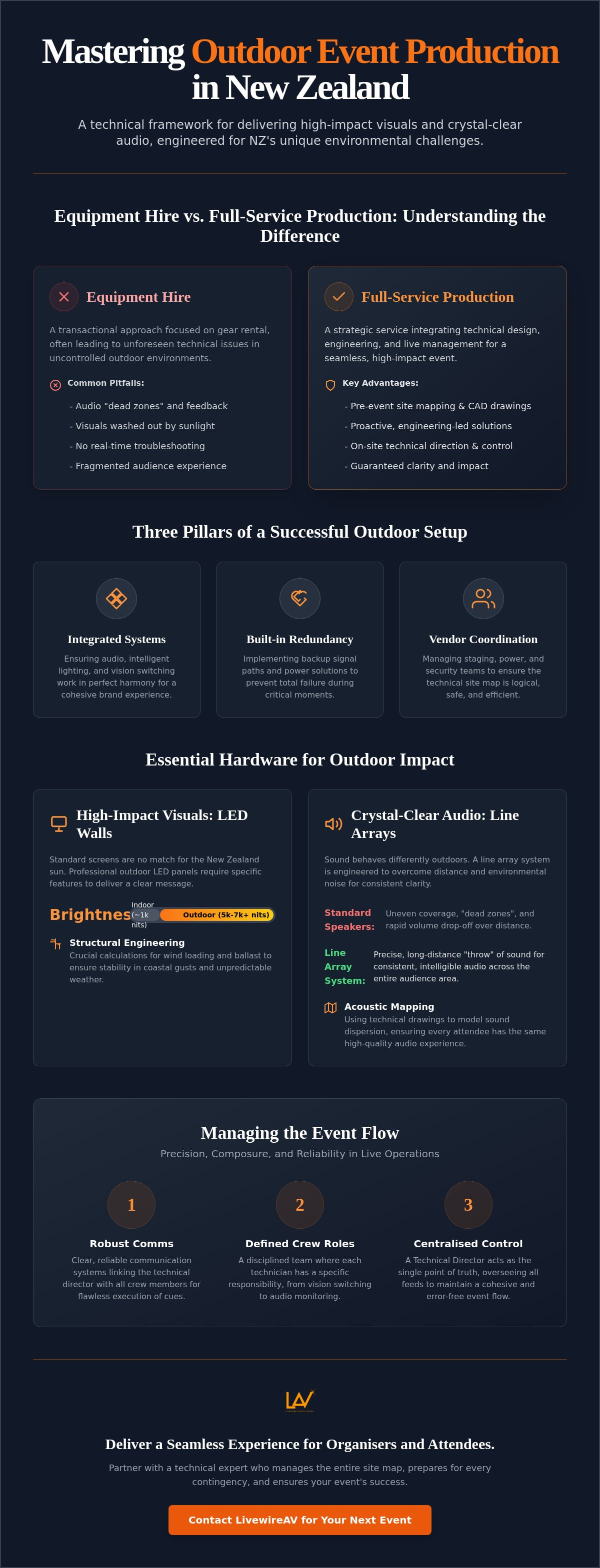
Reliability. Precision. Stability. Successful outdoor event production NZ is far more than the sum of its hardware. It represents the deliberate integration of technical design, high-performance equipment, and proactive live management. While many organisers start by looking for gear, the most successful events are built on a foundation of technical strategy. This approach ensures that every decibel of sound and every lumen of light serves a specific purpose within the larger site map.
The role of a technical director is central to this process. They act as the single point of truth, overseeing audio, lighting, and vision feeds simultaneously to maintain a cohesive environment. This level of oversight is what defines professional Concert production standards. It bridges the gap between having equipment on-site and having a functional, high-impact show. Without a unified technical vision, brand consistency often suffers across large outdoor sites, leading to a fragmented experience for the audience.
The Difference Between Hire and Production
Renting speakers is a transaction; production is a service. In open-air environments, sound behaves differently than it does indoors. Simply placing speakers on stands often leads to "dead zones" where the audience can't hear the speaker, or feedback loops that disrupt the flow. Professional outdoor event production NZ solves these issues before they happen. We utilise pre-event site visits and technical CAD drawings to map out coverage precisely. Having on-site technicians means live cues are managed with composure and any technical variables are addressed in real-time, long before they impact the guest experience.
Key Components of a Successful Outdoor Setup
A robust outdoor technical footprint requires specialised hardware. This includes high-brightness visual technology capable of competing with direct sunlight and audio line array systems designed for long-distance throw. We focus on three critical pillars:
Integrated Systems: Ensuring audio, intelligent lighting, and vision switching work in harmony.
Redundancy: Implementing backup signal paths and power solutions to prevent total failure during critical moments.
Vendor Coordination: Working alongside staging, power, and security teams to ensure the technical site map is logical and safe.
This methodical preparation allows the technical team to remain invisible. It lets the event's content take centre stage while we maintain total control behind the scenes. By managing the entire technical ecosystem, we eliminate the friction that often occurs when multiple vendors operate without a central coordinator.
High-Impact Visuals and Audio: LED Walls and Line Arrays
Hardware choice determines the success of your visual and auditory impact. In an outdoor setting, standard equipment often falls short. High-performance outdoor event production NZ relies on specific engineering choices, such as high-nit LED panels and line array audio, to ensure clarity remains consistent from the front row to the very back of the site. Precision isn't just about volume; it's about the controlled delivery of content in an uncontrolled environment.
Vision switching plays a critical role here. By managing multi-camera feeds, we can provide live Image Magnification (IMAG) that keeps the audience connected to the speaker, regardless of their distance from the stage. If you're planning a large-scale activation, partnering with a professional technical partner ensures these complex vision and audio systems are integrated correctly from day one.
Outdoor LED Screen Technology
Outdoor screens need a high brightness rating, measured in nits, to remain visible under the harsh New Zealand sun. While an indoor screen might offer 1,000 nits, outdoor panels typically require 5,000 to 7,000 nits to compete with direct daylight. Pixel pitch is another factor; it's the distance between the centre of each LED pixel. For large outdoor displays, a slightly wider pitch is often used to balance resolution with the necessary brightness and weatherproofing. Structural integrity is just as vital as the image itself. We account for wind loading and ballast requirements to ensure screens remain stable even in coastal gusts. Using The Purple Guide as a reference for safety standards, our approach prioritises the physical security of the rig alongside the visual output.
Engineering Sound for Open Spaces
Line array systems are the industry standard for outdoor audio because they provide uniform coverage across large crowds. Unlike traditional speakers that lose energy quickly, a line array uses a vertical column of drivers to control sound dispersion. This allows us to "throw" audio across a wide field without overwhelming those standing near the stage. Managing "slap-back," which is the echo caused by sound bouncing off nearby buildings or hills, is a common challenge in open spaces. A seasoned sound engineer doesn't just increase the volume; they tune the system to the specific acoustics of the venue. This meticulous calibration ensures every word of a keynote is heard clearly, even with environmental noise like wind or traffic in the background. Weather-rated, IP-certified gear is used throughout to ensure the show continues safely, regardless of a sudden change in conditions.
Environmental Logistics: Engineering for New Zealand Conditions
New Zealand’s landscape offers stunning backdrops, but it presents unique engineering hurdles. Effective outdoor event production NZ starts long before the first case is unloaded. We conduct thorough technical site visits to assess terrain stability, wind exposure, and power availability. A sloping park or a remote coastal site requires specific ballast calculations and cable management strategies. We identify these constraints early to ensure the technical footprint is secure and the signal remains uninterrupted. Precision. Stability. Control. These are the benchmarks we apply to every site, ensuring the environment supports the production rather than hindering it.
Rigging and staging in high-wind environments require a disciplined approach. We don't treat safety as a checklist; we treat it as a core technical requirement. This involves calculating wind loads for every screen and lighting tower. By understanding the specific physics of a site, we can deploy equipment that remains stable even when the coastal gusts pick up. This meticulous planning allows the event to proceed with the quiet confidence that the infrastructure is built to withstand the elements.
For organisers managing heavy equipment logistics or complex rigging installations, you can visit Bewlake Lift & Haul Ltd to see how professional crane hire services support the safe deployment of large-scale infrastructure.
Weather Mitigation and Contingency Planning
Weather is the most common variable in outdoor events. We don't hope for the best; we engineer for the worst. Our inventory includes IP-rated lighting fixtures and customised protective covers for sensitive vision and audio components. This ensures that a passing shower doesn't result in a system shutdown. We also establish clear "go/no-go" parameters based on live wind speed data. If gusts exceed the safety rating for a specific LED tower, we have a documented protocol to lower the equipment safely. Monitoring live weather feeds allows our technical team to remain proactive, making composed decisions before a situation becomes critical. It's about maintaining total technical control, regardless of what the clouds are doing.
Power Management and Distribution
Large-scale AV rigs require massive amounts of energy. High-output audio line arrays and high-nit LED walls can easily exceed the capacity of a standard venue's electrical infrastructure. We calculate total KVA requirements with precision to avoid overloaded circuits. Daisy-chaining from standard domestic outlets is a recipe for disaster. It leads to voltage drops that can damage digital equipment or cause signal dropouts. Instead, we utilise independent power distribution and synchronised generator backups. This provides the clean, stable power necessary for flicker-free vision switching and reliable livestreaming. By isolating the AV power from other vendors like catering or heating, we eliminate the risk of external surges impacting the show's technical integrity.
Managing the Event Flow: Crew, Cues, and Comms
Precision. Discipline. Timing. Behind every high-impact display is a layer of invisible infrastructure. Event comms, specifically talkback systems, are the nervous system of outdoor event production NZ. They connect the vision switcher to the camera operators and the stage manager to the front-of-house (FOH) engineer. This constant, disciplined flow of information ensures that transitions between a live speaker, video playback, and musical entertainment occur without hesitation. In a large outdoor venue, where technical positions are often hundreds of metres apart, robust wireless and wired comms are a fundamental requirement for professional execution. Without this link, the most advanced hardware cannot deliver a cohesive show.
The Run of Sheet (ROS) serves as the definitive blueprint for these complex operations. It is a shared document that aligns every technical department, from lighting to vision. By detailing every cue, asset, and transition in chronological order, the ROS eliminates ambiguity during high-pressure moments. It allows the technical director to lead with quiet confidence, knowing every crew member is on the same page. When the crew is synchronised through a well-prepared ROS and a reliable comms loop, the entire outdoor event production NZ moves with a sense of purpose and stability. This level of preparation ensures that excellence is a standard requirement rather than an occasional achievement.
The Technical Crew: Who Is Behind the Desk?
Balancing live sound while managing a simultaneous broadcast feed requires deep technical literacy. At the desk, a FOH engineer must account for open-air acoustics while ensuring the livestream remains crisp. Experienced Professional Event Technicians NZ stay calm when live variables shift. Their composure is their greatest asset, keeping the team focused during off-script moments. If you need a team that thrives under pressure, you can contact our technical production team today.
Multi-Camera Production and Vision Switching
Vision switching is the art of real-time storytelling. By utilising varied camera angles, we create a dynamic experience for the audience. This is vital for large outdoor screens where live IMAG is used. We ensure low-latency processing so the screen matches the speaker perfectly. By integrating pre-recorded branding and live camera feeds into a polished programme, we maintain a professional, high-impact flow throughout the event.
Partnering with LivewireAV for Seamless Outdoor Production
Precision. Composure. Reliability. Choosing a partner for outdoor event production NZ is a decision based on trust. We position ourselves as the steady hand behind the scenes, possessing the deep technical knowledge required to handle complexity while remaining invisible enough to let your work take centre stage. By providing end-to-end technical management, we offer a single point of contact. This eliminates the friction often found when coordinating multiple vendors. You get total technical control without the logistical stress. We understand that in high-stakes environments, precision and composure are the most valuable commodities.
Our commitment to excellence is reflected in our inventory and our process. We utilise modern, high-spec hardware, including audio line array systems and intelligent lighting design, to ensure every guest has a premium experience. However, the gear is only as effective as the plan behind it. We prioritise meticulous, site-aware execution. Every cable run, power calculation, and signal path is accounted for long before the first guest arrives. This disciplined approach ensures that your event remains seamless, high-impact, and entirely professional. Excellence is our standard requirement, not an occasional achievement.
National Reach and Local Expertise
Logistics for large-scale events can be daunting. We manage the entire process, whether your event is in a metropolitan centre or a remote regional park. Our team understands the specific technical requirements of various national venues, from power constraints to acoustic challenges. This venue-aware approach allows us to anticipate issues before they arise. For a broader look at our standards and approach, you can read our guide on Premium Event Production New Zealand. This national reach ensures consistency and reliability regardless of where you choose to host your activation.
Tailored Proposals for Unique Events
We don't start with a gear list. We start with a deep dive into your goals. Understanding the desired outcome allows us to build a technical solution that actually works for your specific site and audience. Our communication is transparent and direct. We provide detailed quotes that leave no technical gaps, ensuring there are no surprises on show day. Every proposal is a collaborative partnership designed to provide peace of mind. If you are ready to master the technical complexities of your next project, you can organise a consultation for your next outdoor event with LivewireAV.
Delivering Technical Certainty for Your Next Outdoor Event
Mastering the technical complexities of an open-air venue requires more than just high-end equipment. It demands a site-aware strategy that accounts for New Zealand’s unpredictable weather and power constraints. By prioritising high-nit LED walls for daytime visibility and calibrated line array systems for uniform audio coverage, you ensure your message reaches every attendee with absolute clarity. Disciplined crew communication and a detailed Run of Sheet provide the final layer of stability, allowing you to focus on the event's purpose while the technical team manages the site map.
With over 10 years of technical production experience, LivewireAV provides the quiet confidence needed for high-stakes environments. Our modern inventory and comprehensive national technical management ensure that excellence is a standard requirement for every outdoor event production NZ. We take the stress out of the technical site visit, the rigging, and the live cues. You can discuss your outdoor event production requirements with our expert team to secure a partner who values precision as much as you do. We look forward to helping you deliver a seamless, high-impact experience for your audience.
Frequently Asked Questions
What is the main difference between event hire and event production?
Event hire involves the simple rental of equipment, while event production is the comprehensive integration of design, hardware, and live technical management. Production includes pre-event site visits, technical CAD drawings, and on-site specialists who manage live cues. This managed approach ensures that audio, vision, and lighting systems work as a single, cohesive unit under the direction of a technical lead.
How do you protect expensive AV equipment from the New Zealand weather?
We utilise IP-rated, weather-resistant fixtures and bespoke protective housings for all sensitive electronics. Technical control positions are housed in dedicated, weather-tight structures, and we use waterproof cable connectors across the entire site map. Our team monitors live weather feeds constantly, allowing us to take proactive steps to secure the rig before a change in conditions occurs.
Can LED walls be seen clearly in bright, direct sunlight?
Outdoor LED walls are engineered for high-brightness environments and remain vivid even in direct sunlight. We use panels with a rating of at least 5,000 nits, which is significantly brighter than standard indoor screens. This high-nit threshold ensures that branding, presentations, and live camera feeds remain clear and impactful for every member of the audience throughout the day.
What kind of power supply is required for a large outdoor event?
Large outdoor events typically require a dedicated three-phase power supply, often delivered via synchronised backup generators. We calculate the total KVA load required for your specific LED walls and audio line arrays to ensure the system remains stable. Using independent power distribution prevents the signal interference and voltage drops that often occur when sharing power with catering or other site vendors.
How many technicians are typically required for a corporate outdoor production?
A standard corporate outdoor production usually requires a core team of three to six specialists. This team typically includes a front-of-house engineer, a vision switcher, and a stage manager to coordinate live transitions. The exact number of technicians depends on the complexity of your camera packages and the scale of the site's technical footprint.
Do you provide livestreaming services for outdoor events in remote locations?
We deliver stable livestreaming services in remote areas by utilising bonded cellular technology or satellite links. This approach allows us to maintain a high-definition broadcast feed even when local internet infrastructure is unreliable or non-existent. Our technical team manages the entire signal path to ensure your virtual audience experiences the same professional quality as those on-site.
How far in advance should I book technical production for an outdoor event?
We recommend engaging a partner for outdoor event production NZ at least three to six months before your event date. This timeframe allows for necessary site visits, technical design phases, and coordination with local councils for any required permits. Early booking ensures that the most appropriate hardware and senior technical crew are secured for your project.
What happens if the wind speed exceeds safety limits for the staging or screens?
Safety is a core technical requirement, and we establish clear wind-speed thresholds for every rig during the planning phase. If live monitoring shows that wind speeds are approaching these safety limits, we follow a documented protocol to lower LED walls and lighting towers to a secure position. These "go/no-go" parameters are non-negotiable and are designed to protect the audience, the crew, and the equipment.


Comments