Line Array or Point Source PA: Which Suits Your Event
A bigger PA isn’t automatically better-sounding. Knowing when to use a line array for an event depends on the venue, audience layout and coverage required. A point-source system can sound clear when its output and coverage suit the space. A line array can help serve a widely spread audience or project sound over longer distances.
A larger crowd or an outdoor setting doesn’t automatically call for a line array. The key is matching the system to the event: compact venues and intimate gatherings can often work well with point-source speakers, while active line arrays are suited to outdoor music festivals and stadium concerts.
This guide compares point-source systems and line arrays, explaining when an active line array may suit your event. You’ll learn how audience layout, venue acoustics, distance and programme affect the decision, and how to weigh the options without treating speaker size as a shortcut for sound quality.
Table of Contents
Line array coverage, directivity, power and scalability
Choose by coverage, distance and site layout, not speaker size alone. The configuration determines where sound travels and how evenly it reaches listeners.
Uniform coverage across wide listening areas
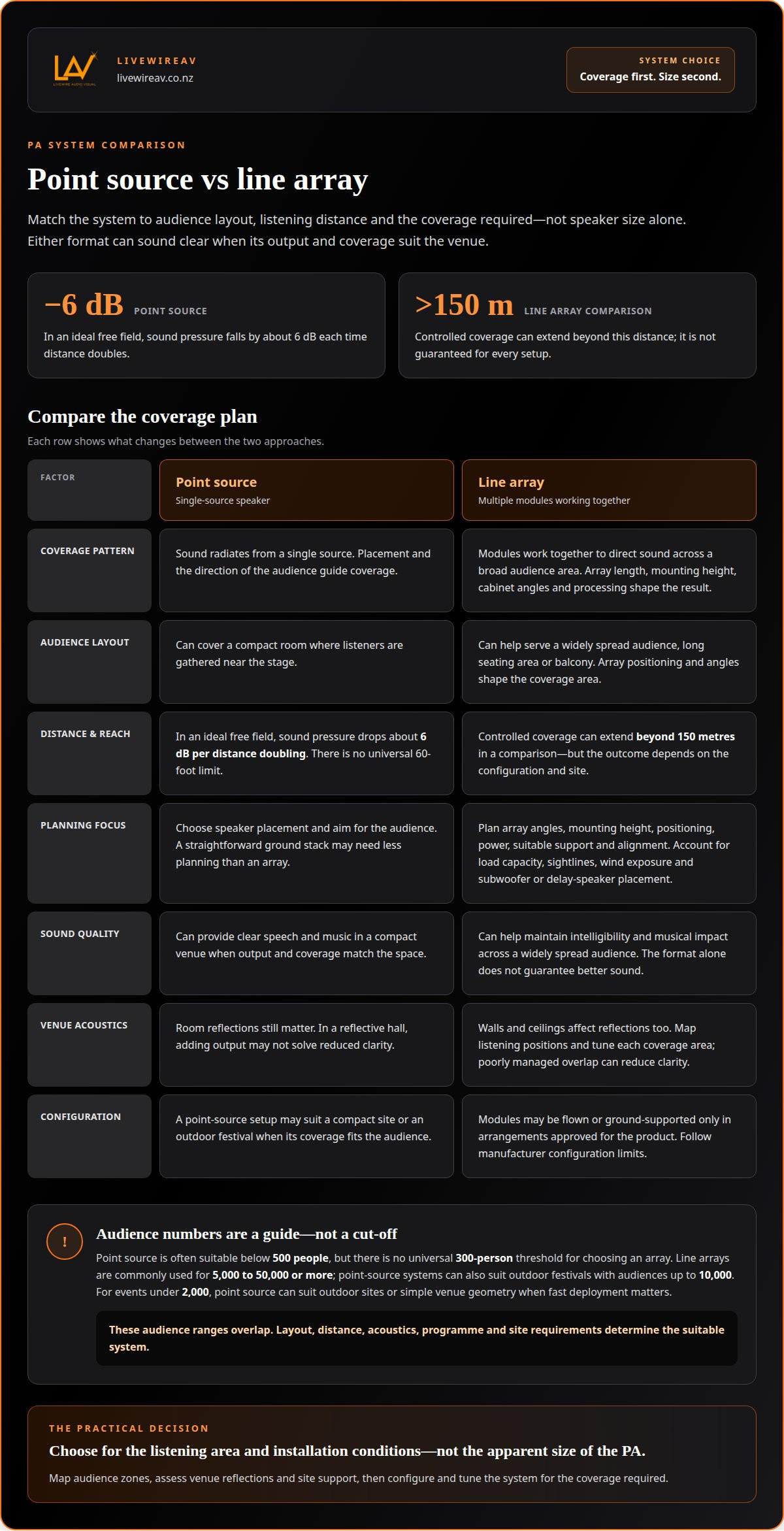
A line array uses modules designed to work together, helping direct sound across a broad audience area. Its coverage depends on array length, mounting height, cabinet angles and processing, so the configuration must suit the room or site. By comparison, a point-source speaker radiates from a single source; in an ideal free field, its sound pressure drops by about 6 dB each time distance doubles. There is no universal 60-foot limit for point-source speakers.
Line-array configuration and coverage overlap
Array length and module angles shape vertical coverage, while positioning helps set horizontal reach. A comparison gives line arrays controlled coverage to more than 150 metres, but that is not a guaranteed result for every setup. Delay speakers can extend coverage into distant areas; their timing and level need alignment with the main system. Poorly managed overlap can make the combined sound less clear, so map audience zones and tune each coverage area as part of the system configuration.
Power, rigging and space requirements
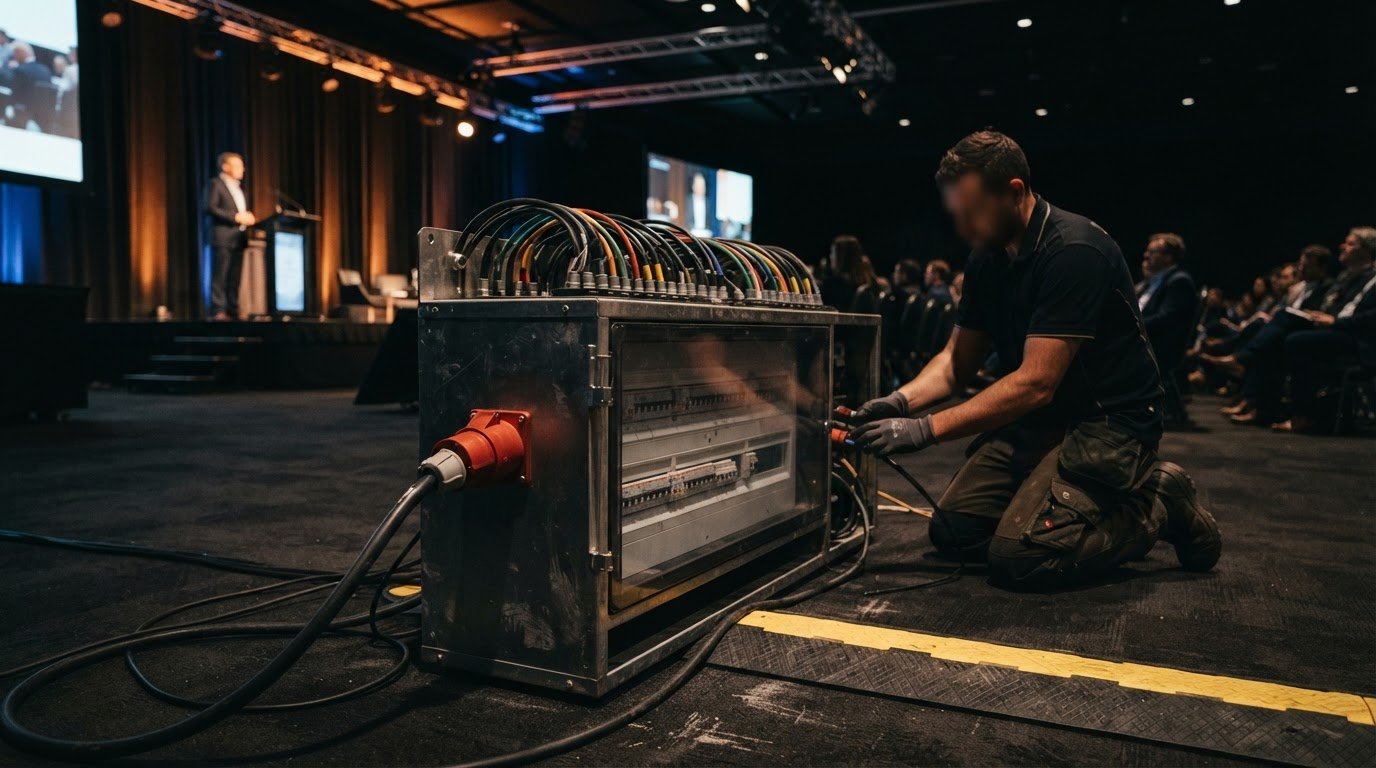
A line array needs planned power, space and suitable support. Consider load capacity, sightlines, wind exposure, power supply, subwoofer placement and delay systems when planning the site. A line array should be installed and configured with care, taking account of the site and equipment. Modules may be flown or ground-supported only in arrangements approved for the product, and manufacturer configuration limits must be followed. These requirements make a line array more involved than a simple point-source ground stack, particularly where stage space or rigging options are limited.
Choose the system whose coverage and installation requirements best suit the audience area and site.
Can a point source PA system sound as good as a line array?
Yes. Either system can deliver clear sound when its output and coverage match the venue. The decision depends on audience size and layout, room acoustics, programme and how sound needs to reach listeners.
Audience experience and sound quality
A well-matched point-source system can provide clear speech and music in a compact venue without the scale or rigging of an array. A line array can help maintain intelligibility and musical impact across a widely spread audience. Neither format guarantees better sound by itself: driver selection, system design and tuning all affect the result. In a reflective hall, reflections can increase sound levels while reducing clarity, so simply adding output may not solve the problem.
Audience layout and venue acoustics
Start with the venue plan. In a compact room with listeners gathered near the stage, point-source speakers may cover the audience directly. A balcony, long seating area or wide festival audience creates different coverage demands. A line array can focus sound towards the audience and reduce excessive vertical spread. Rigging and sightlines also affect placement, while walls and ceilings influence reflections. Choose a configuration based on listening positions, not just the room’s overall dimensions.
Audience numbers are a guide, not a fixed threshold. Point source is often suitable below 500 people, but there is no universal 300-person cut-off for choosing an array. Line arrays are commonly used for events of 5,000 to 50,000 or more people, while point-source systems can also suit outdoor festivals with audiences up to 10,000. For events under 2,000 people, point source can suit outdoor sites or venues with simple geometry when fast deployment matters. These ranges overlap because layout and coverage needs differ.
For a venue-specific comparison, event sound planning can help connect audience layout and programme requirements with a suitable system approach.
Line array definition and speaker arrangement
A line array is a professional loudspeaker system made up of multiple speaker modules arranged vertically. The modules are usually set in a straight or curved line, with identical units working together as a coherent sound source. They are fed in phase, so their output combines as part of one designed system rather than operating as separate, uncoordinated speakers.
The array’s shape and position depend on the event configuration. It can be flown from a truss, ground-stacked or mounted on towers. For example, a stage with suitable overhead support may use a flown array, while a ground-supported arrangement may suit a site without overhead rigging. The system design and manufacturer limits determine which arrangements are suitable.
Each module contributes to the array’s coverage, but adding speakers isn’t simply a matter of making the system louder. Array length, mounting height, cabinet angles and processing all affect where sound travels. Modules can be added or removed to adapt the system to the venue, while their angles help shape the coverage pattern. Near-field and far-field behaviour also varies with frequency and distance, so the same configuration won’t behave identically throughout the audience area.
For an outdoor event, the stage position, audience depth and available support all inform the layout. A designer maps the intended listening area, selects an approved arrangement, then sets module angles and processing to direct sound towards that area. A curved array can aim different sections towards different audience zones, while a straight line uses different geometry. The result depends on the complete configuration, not just the number of cabinets.
Think of the modules as one coordinated system. Their arrangement shapes the array’s coverage and directs sound across the space.
When active line arrays suit events
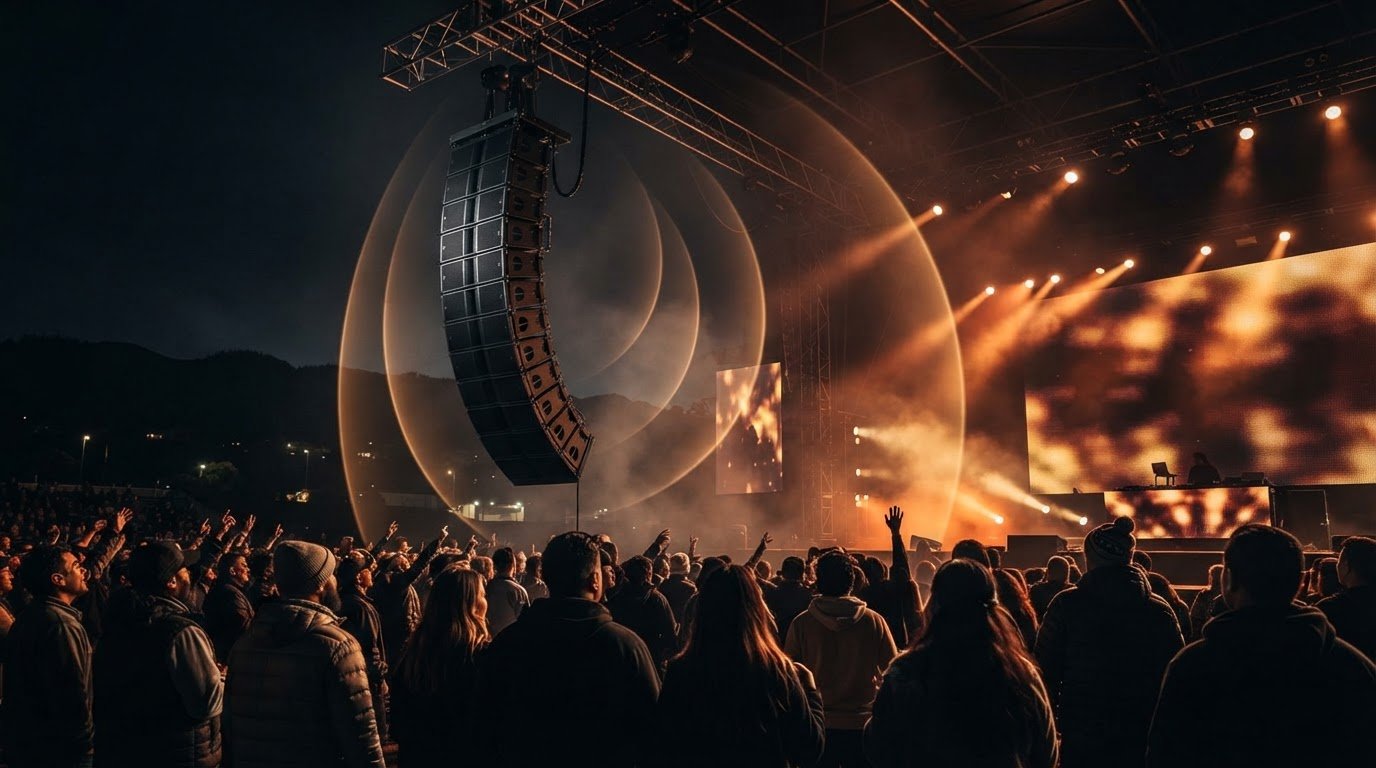
A line array PA system suits events where sound needs to reach a large or widely spread audience with controlled coverage. Active line arrays are recommended for outdoor music festivals and stadium concerts. Concerts, large conferences and festival stages are also common line-array settings.
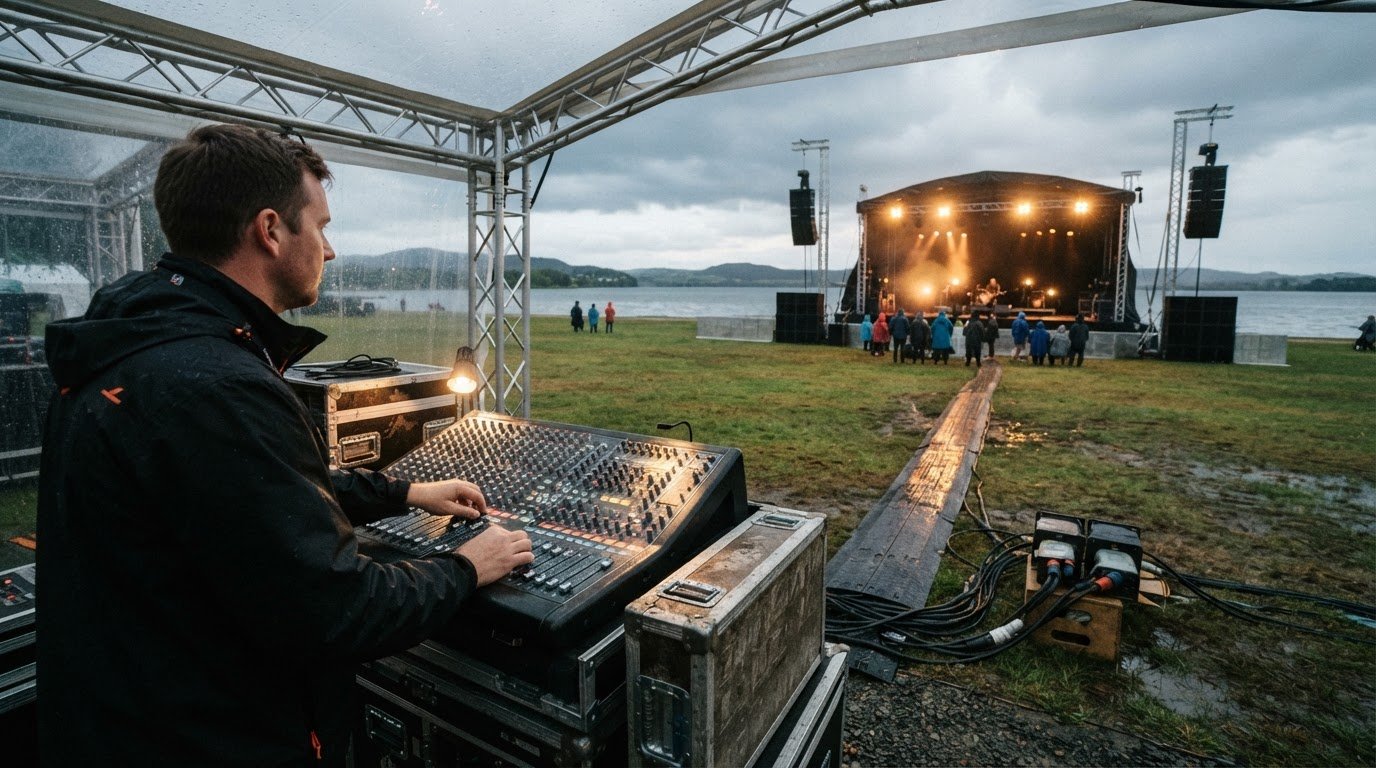
Outdoor events can benefit from directional control, particularly where ambient noise or complex acoustics affect the site. But being outdoors doesn’t automatically mean an array is necessary. Another configuration may serve a compact audience area; the deciding factors are audience spread, required coverage and programme.
Scale is one useful signal. Outdoor stages with attendance above 20,000 people are a recognised use case for line arrays. For a concert or large gala, arrays are commonly flown from a truss or tower on either side of the stage. That arrangement can direct sound across a deeper audience area, rather than concentrating it near the stage.
Match the system to the event’s content as well as its footprint. Rock concerts and electronic music festivals may call for high-energy playback, while classical performances place different demands on sound. Subwoofer choice should reflect the programme, target level and main speakers’ usable frequency range. These decisions shape the complete production, not just the array.
Use this practical sequence: map the audience and listening areas, identify the furthest and widest coverage required, then match the speaker system and subwoofer to the programme. Consider an active line array when these needs point to long-distance, controlled coverage, not simply because attendance is high or the event is outdoors. A point-source system can still suit the venue when its output and coverage are sufficient.
Plan event sound production around your audience layout, programme and site requirements.
LivewireAV: Full Technical Production
LivewireAV provides Full Technical Production for events where sound needs to work as part of a coordinated setup. If your audience is spread across a large venue or your programme includes live music, its Audio Line Array Systems are relevant to the decision. The right approach depends on audience layout, venue and production requirements, not attendance alone.
For a conference, festival or outdoor production, LivewireAV can coordinate audio with Hybrid & Livestream Events or LED Walls & Projection when those elements are part of the event. This is a practical next step when weighing point-source speakers against an active line array and considering the production requirements together.
Contact LivewireAV to discuss your event’s sound and production needs.
Plan the sound around your event
Make the PA decision part of the wider production plan, not a last-minute equipment choice. The event brief should connect the audience layout, programme and venue with the experience you want people to have. This gives you a practical basis for deciding when to use a line array for an event and how sound fits with the other technical elements.
LivewireAV’s Full Technical Production brings event requirements together, with Hybrid & Livestream Events and LED Walls & Projection available where they support the programme. A clear discussion about your venue, audience and production priorities can help shape the next steps.
Discuss your event with LivewireAV and move forward with a sound plan built around what your event needs.
Frequently Asked Questions
When should I use a line array instead of a regular PA?
Choose a line array when the event layout calls for more controlled coverage than a conventional PA arrangement can provide. For example, a concert with a deep audience area and side seating may need sound directed across several listening zones. Consider the programme too: amplified bands place different demands on a system than a speech-led presentation. The right choice supports the audience experience without adding unnecessary complexity.
What event size and audience capacity needs a line array?
There isn’t a single audience capacity that automatically calls for a line array. Two events with the same attendance can have different needs if one has a compact seated layout and the other spreads people across a long standing area. Start with the venue plan, stage position and programme, then assess whether a simpler PA configuration can serve the audience or an array’s coverage approach is needed.
How do venue size, shape and audience distance affect line array choice?
Consider where people will actually listen, not just the venue’s total floor area. Side seating, a balcony or an open dance floor creates different listening positions. Mark these zones on the event plan, including areas near the stage and at the back. This helps show whether the main system can serve them directly or the layout needs additional coverage planning.
Line array vs point source speakers for live events: which is better?
Neither is automatically better. Choose the option that delivers the required result for the event. A point-source setup may suit a focused audience and straightforward stage layout; a line array may fit a production with more demanding coverage needs. During soundcheck, listen from several audience positions, including the front, centre and rear, to assess consistency and speech or music clarity.
How many line array speakers are needed for an event?
The required number depends on the system design, audience area and intended coverage, so attendance alone can’t determine it. Module count affects the array’s behaviour, while cabinet angles, mounting height and processing shape where sound is directed. For a useful design brief, provide the venue layout, stage position, audience arrangement and programme. These details inform the system configuration instead of relying on a generic speaker count.
When is a line array unnecessary or unsuitable for an event?
A line array may be unnecessary for a small ceremony, intimate dinner or compact venue where a point-source system can serve the audience—a practical approach often taken by event DJ and music specialists like Easy Cee Entertainment to ensure balanced, unobtrusive sound. It may also be unsuitable if the proposed arrangement doesn’t follow the product’s approved configuration or suit the venue’s support conditions. A large array can be visually intrusive or acoustically unbalanced when it exceeds the event’s actual coverage needs, so match the system to the site and programme.
Comments