Line Array Sound Systems and How They Shape Concert Sound
Coverage depends on how loudspeakers work together, not simply on how much power they produce. In practical terms, what a line array sound system is can be understood as a vertical set of speaker enclosures designed to control how sound spreads across an audience. Their combined direction and spacing help shape where sound travels.
That makes line arrays useful for more than simply making a concert louder. Their design affects how evenly sound reaches different parts of a venue, while the array’s length influences its behaviour across frequencies.
This article explains how line arrays focus and distribute sound, why array length matters to frequency response, and how systems are flown or ground-stacked. Understanding these fundamentals makes it easier to see how a system can be matched to a venue and its audience.
Table of Contents
Array length and frequency response
Core components include speaker enclosures, low-frequency drivers and high-frequency waveguides. The number and arrangement of enclosures depend on audience coverage, venue dimensions and the shape of the listening area.
How array length affects frequency response
Array length is the combined vertical span of connected enclosures, and it affects how consistently their sound combines across frequencies. In real public-address systems, classical line-array theory is a useful approximation mainly from 100-400 Hz. Below 100 Hz, an array shorter than about 3 metres may begin behaving more like an omnidirectional source, spreading bass more broadly.
Wavelength helps explain this behaviour. A 100 Hz sound wave has a wavelength of 11.3 feet (3.4 metres), so a short array may be too small to control its direction at that frequency. Array length therefore influences low-frequency directivity, but it does not determine the entire frequency response by itself.
Low-frequency driver size also varies by format. Driver size can vary between large- and mid-format arrays, alongside other design choices. These examples help distinguish system designs, but the drivers work alongside enclosure layout and processing to shape the overall output.
At higher frequencies, waveguides direct sound from each enclosure and help shape vertical coverage. The angle between neighbouring boxes affects how their outputs combine across the audience. A longer array’s overall behaviour depends not only on its enclosure count, but also on those angles and the waveguides’ coverage pattern.
Choosing speaker quantities for audiences and venues
There is no single speaker count that suits every audience or venue. The required number depends on the audience footprint, the distance sound must travel and how evenly it needs to cover seats or standing areas. A wide, deep audience area presents different coverage demands from a compact space with a shallow audience.
Planning starts with the listening area, not just the audience headcount. The array’s length and vertical coverage must suit the venue’s geometry, and low-frequency requirements also influence the design. A technician considers where listeners will be positioned and how the enclosures can direct sound towards them.
A useful assessment brings together three details: the audience’s shape, the venue’s dimensions and the intended coverage. For example, a long audience area may need sound directed towards the rear as well as the front. Enclosure count is one part of the wider design, alongside array length, driver format and high-frequency waveguide behaviour.
Flying and ground-stacking arrays
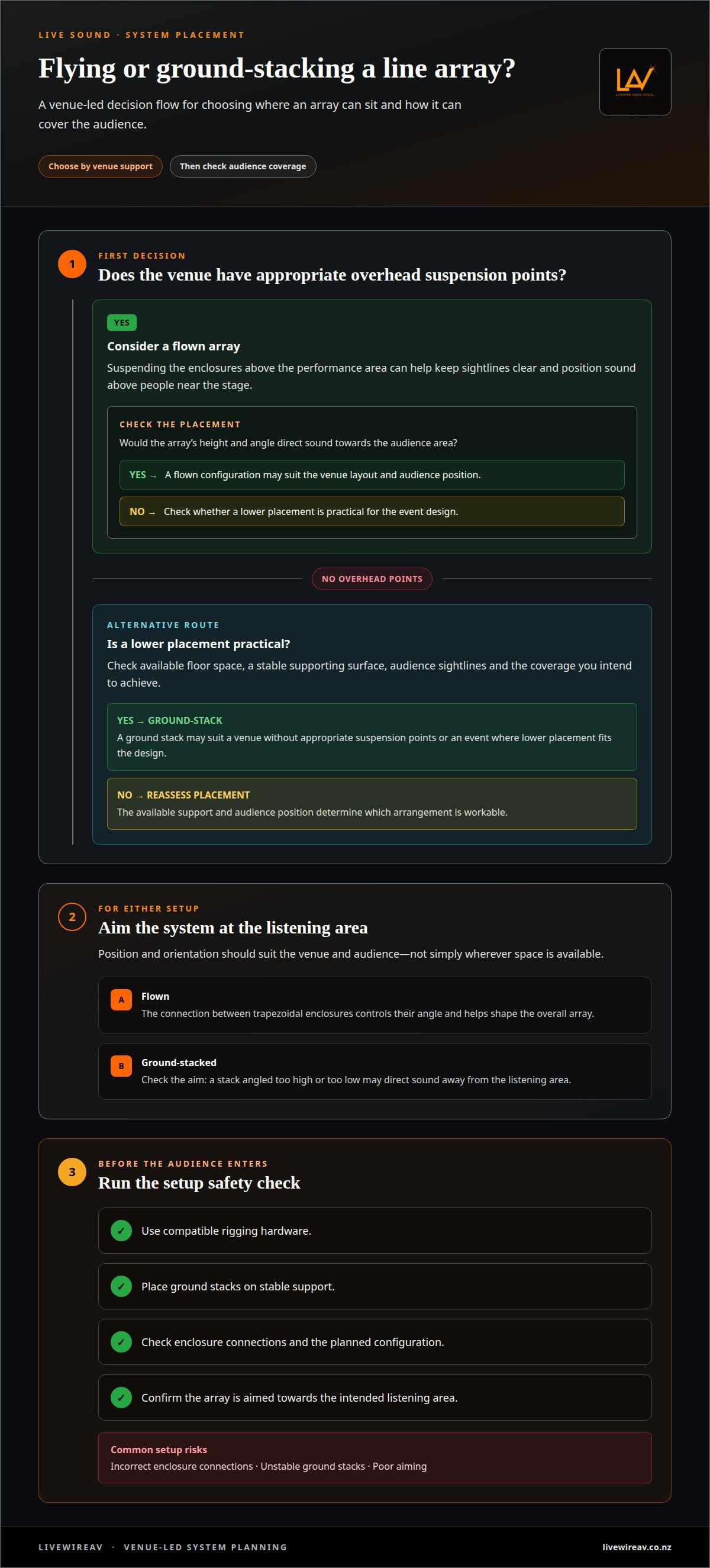
Line-array enclosures are typically trapezoidal, so they can be connected at planned angles. Specialised rigging hardware joins the boxes, whether the array is flown or ground-stacked. The choice affects where the system can be positioned and how it covers the audience.
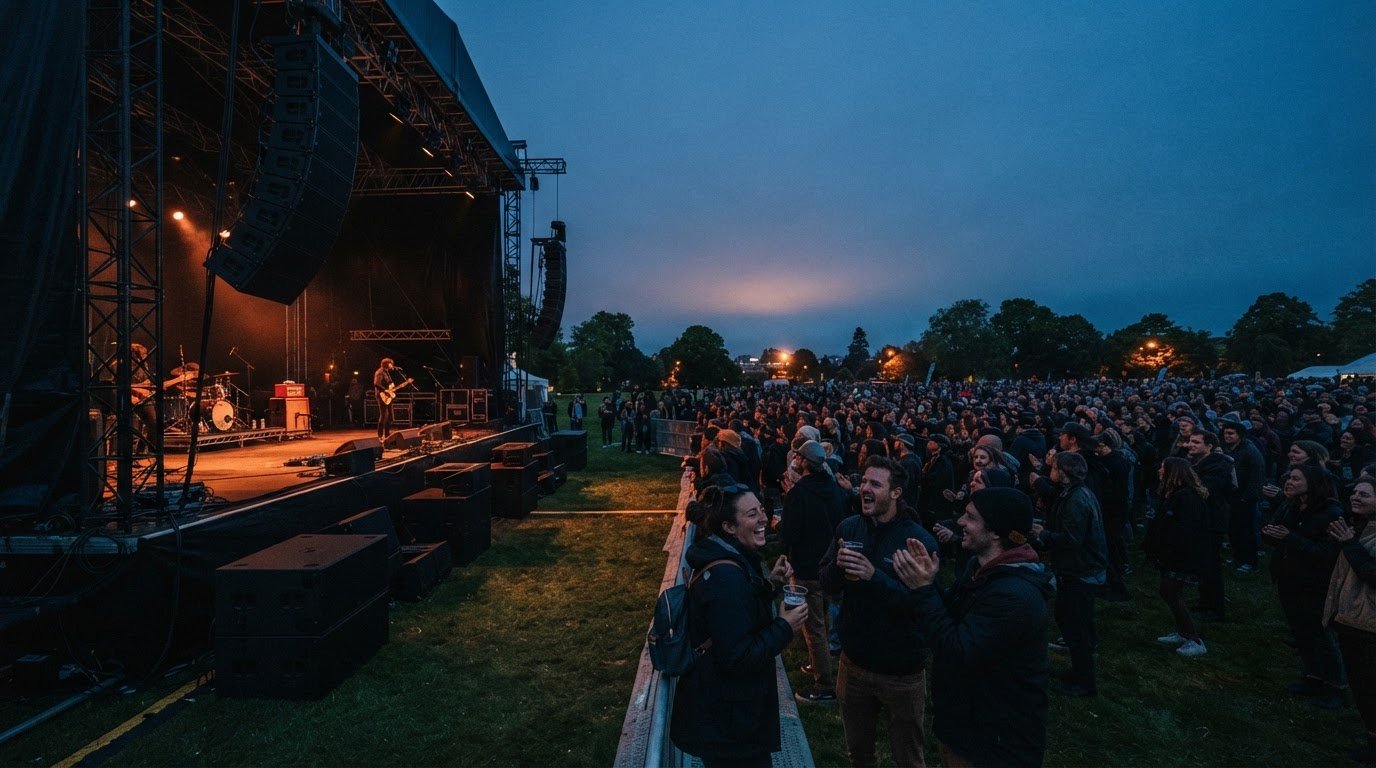
A flown array is suspended above the performance area using its rigging system. Raising the enclosures can help keep sightlines clear and position sound above people near the stage. The array’s height and angle affect where its output is directed, so placement should reflect the venue layout and audience area.
Ground-stacked arrays sit on a supporting surface. This approach can suit venues without overhead suspension points or events where a lower placement fits the design. Available floor space, audience sightlines and intended coverage all help determine whether a ground stack is practical.
Common setup risks include incorrect connections between enclosures, unstable ground stacks and poor aiming. Reduce these risks by using compatible rigging hardware, placing ground stacks on stable support and checking the planned configuration before the audience enters.
For flown systems, the connection between each trapezoidal enclosure controls its angle and helps shape the overall array. Ground-stacked systems also need careful placement: a stack aimed too high or too low may direct sound away from the listening area. In either setup, position and orientation should suit the venue, rather than being dictated by wherever space is available.
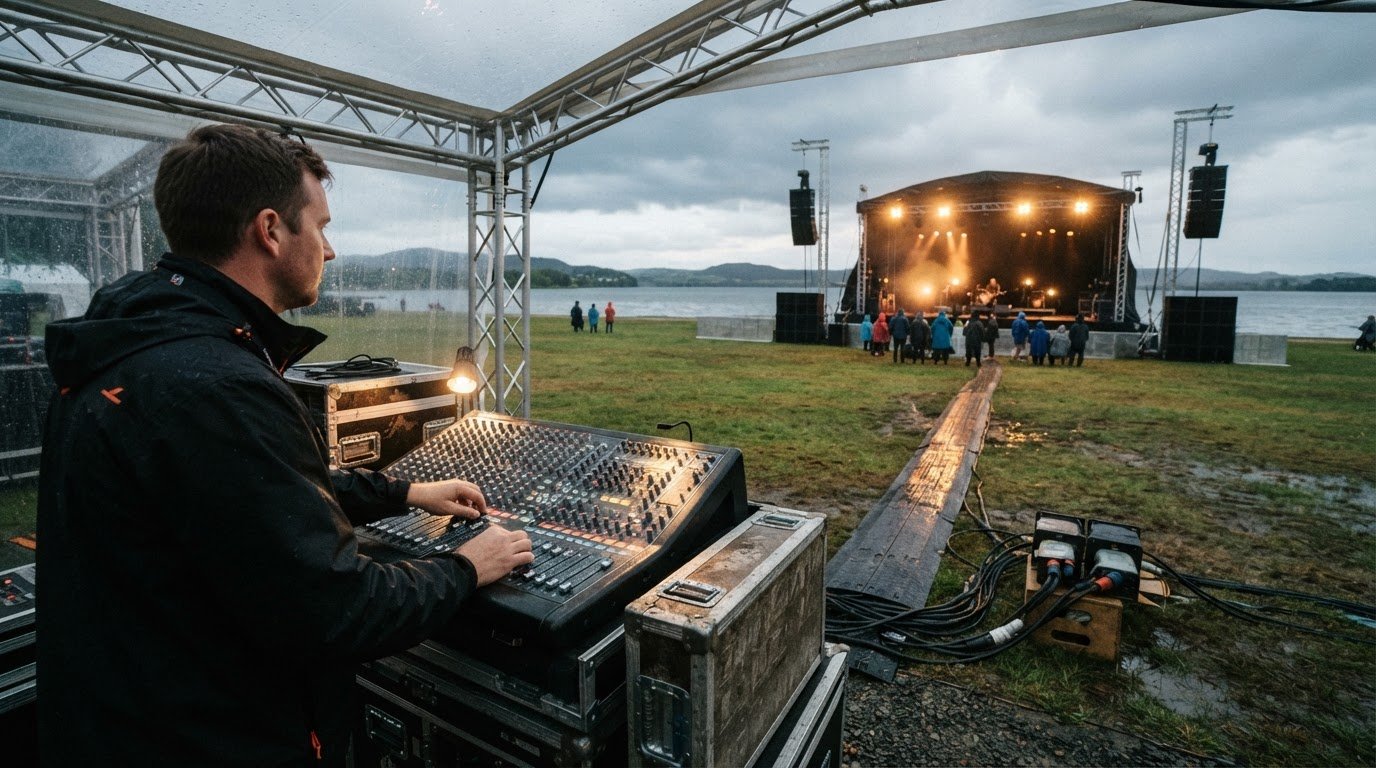
At an outdoor event, a flown configuration may keep equipment clear of busy floor areas, while a ground stack may suit a site without appropriate suspension points. Indoor venues offer different placement options depending on their layout. These are planning considerations, not fixed rules: the audience position and available support determine which arrangement is workable.
For events where placement, coverage and staging need to work together, careful sound system planning can help align the setup with the venue.
History of concert line arrays
Concert line arrays draw on acoustic ideas developed before modern concert systems. Harry Olson developed loudspeaker column line-array concepts using findings published in his 1957 text, Acoustical Engineering. The connection matters: the column arrangement was not simply a stack of speakers, but a way to apply acoustic principles to how sound combines. Olson’s work established an early conceptual foundation for later loudspeaker designs. It also helps explain why the geometry of an array remains central to its behaviour.
In 1983, Joseph D’Appolito suggested a multi-band line-array element in a horizontally oriented enclosure. This was a distinct design step from Olson’s loudspeaker-column concepts. The multi-band element brought different frequency ranges into one enclosure design, while the horizontal orientation described a specific arrangement. Together, those details show how line-array thinking developed through changes to both the loudspeaker element and its configuration. They also illustrate why the term covers evolving design approaches rather than one fixed speaker layout.
A major concert example followed in 1974, when the Grateful Dead used the Wall of Sound on tour. It was an early large-scale implementation of line-array principles in concert sound reinforcement. The example placed those principles in a touring context, where sound had to serve a live audience rather than remain an acoustic theory. The Wall of Sound’s place in this history reflects the scale of the ambition, not a claim that every later line array uses the same design.
These milestones show different parts of the development. Olson’s 1957 text connects acoustic findings with column concepts; D’Appolito’s 1983 proposal describes a multi-band element; and the Grateful Dead’s 1974 tour demonstrates an early large-scale concert application. The dates aren’t a simple sequence of invention, refinement and adoption. Instead, they help distinguish theoretical foundations, a proposed enclosure design and practical use on tour. That distinction gives listeners a clearer way to understand how line-array systems became part of concert sound reinforcement.
How line arrays focus and distribute sound
Line arrays combine loudspeaker enclosures to shape sound coverage across an audience. Their orientation and aiming influence which listening areas receive the strongest sound.
How line arrays work
To understand what a line array sound system is, start with how its enclosures work together. Their combined output can direct sound across a listening area instead of radiating from one point in every direction. This can help address differences between audience positions.
In free-field conditions, an ideal line source loses about 3 dB each time distance doubles. A point source loses about 6 dB over the same distance. This comparison describes idealised behaviour; the venue and system configuration also affect what listeners hear.
Horizontal coverage is typically 90 degrees. Vertical coverage depends on the array configuration. For example, a 12-box array aiming for 60-degree vertical coverage would use about 5 degrees per horn to match that spread. A spiral array can use changing angles, from 1° near the top to between 6° and about 10° near the bottom. These examples show how enclosure angles help shape coverage.
Comparing line arrays with point-source speakers
A point-source speaker radiates sound from one location, while a line array combines the output of several enclosures. Understanding what a line array sound system can do clarifies the trade-off: its coverage can be shaped across a wider listening area, but the configuration needs careful planning.
A line array may suit a venue with a broad or deep audience area. A point-source system may work well in a compact space with a more contained listening area. The right approach depends on audience positions, room shape and required coverage, not just the event’s audience size.
To plan coverage, map the listening area, set enclosure angles to address it, then assess sound at different audience positions. This helps identify gaps and areas receiving excessive sound. Venue dimensions and audience layout guide these decisions, while line array coverage planning can account for how the system is aimed across the space.
LivewireAV: Full Technical Production
LivewireAV provides Audio Line Array Systems as part of Full Technical Production for events that need carefully planned sound coverage. The team can match the system design to the venue, audience layout and event requirements, integrating audio into the wider production plan.
This is useful when a concert, conference or outdoor event needs sound coordinated with other technical elements. LivewireAV also provides Hybrid & Livestream Events and LED Walls & Projection, helping bring audio together with the event’s visual and broadcast needs.
For a venue-specific discussion about line array sound and event production, contact LivewireAV.
Plan sound around the experience you want to create
Understanding what a line array sound system can do is a useful starting point. The next step is applying that knowledge to your event. Consider where the audience will gather, how the programme will move between speakers or performers, and how the venue layout affects sightlines and sound coverage. These decisions help shape a production plan that supports the event.
For a concert, conference or outdoor production, bring these practical details into the early planning conversation. A clear picture of the venue and event format gives the technical team a strong basis for coordinating sound with staging and other production elements.
To discuss sound systems for your event, contact LivewireAV about sound systems. A considered plan is a steady foundation for a well-run event.
Comments