Shareholder Meeting Technical Production and Failover Planning
New Zealand companies generally must hold at least one shareholders’ meeting each year, with the annual meeting held within six months of the balance date and no later than 15 months after the previous annual meeting. A company’s first annual meeting is due within 18 months of incorporation. These deadlines shape shareholder meeting technical production, from rehearsal timing to reliable transmission and recording.
The meeting itself is only part of the preparation. Shareholders need clear audio and video, a reliable way to follow proceedings remotely if the meeting is hybrid, and a considered plan for questions, voting and technical interruptions.
This guide explains the New Zealand meeting requirements, the recordings and archive materials to plan for, and how separate internet paths and live failover procedures support continuity. It also outlines the production decisions that help keep the proceedings clear, controlled and accessible from rehearsal through to post-event delivery.
Table of Contents
Annual shareholder meeting requirements
New Zealand companies generally hold an annual shareholders’ meeting, subject to a narrow exception. Timing, the company’s constitution and the meeting format all affect production planning.
Choosing a technical production company
A technical production team coordinates the people and systems that help proceedings run clearly. For a shareholder meeting, choose a team that can align production with the agenda, venue and participation format. Proxy results, shareholder questions and voting can all affect the running order, so legal and investor-relations teams should coordinate these timing-sensitive items with production before the event.
Comparing venue audiovisual and livestreaming facilities
Venue facilities affect how well shareholders in the room and online can follow the meeting. Compare audio coverage, camera positions, display visibility, livestream capability and internet arrangements. A room with suitable screens may still need additional camera coverage or audio reinforcement for remote participants. Assess sightlines and cable routes alongside the venue layout, agenda and audience format.
Planning technical production for an AGM
AGM production planning connects legal timing, meeting content and technical delivery. Under the Companies Act 1993, section 124 and Schedule 1 govern aspects of how meetings are run. Companies generally hold one annual shareholders’ meeting each year, no later than six months after the balance date and 15 months after the previous annual meeting. The first annual meeting is due within 18 months of incorporation.
Map the agenda, voting points, proxy results and question periods with the legal and investor-relations teams. Finalise presentation content before technical rehearsals, then run a full-crew dress rehearsal. Check disclosure labels and allow contingency time in the schedule.
Managing hybrid meeting participation
A hybrid meeting needs a clear process for votes, questions and proxy participation across in-person and online channels. The chair’s run sheet should show when each item opens, how responses are collected and how results reach the meeting team. Coordinate proxy results with legal and investor-relations teams so they are ready at the relevant point in the agenda.
Some company decisions can be made without a live meeting through written resolutions. For meeting participation, distinguish those resolutions from live voting and make the process clear to attendees. A company may omit its annual meeting only if its constitution does not require one and the board resolves that no meeting is in the company’s interests because shareholders have nothing to do.
Redundant transmission and failover planning
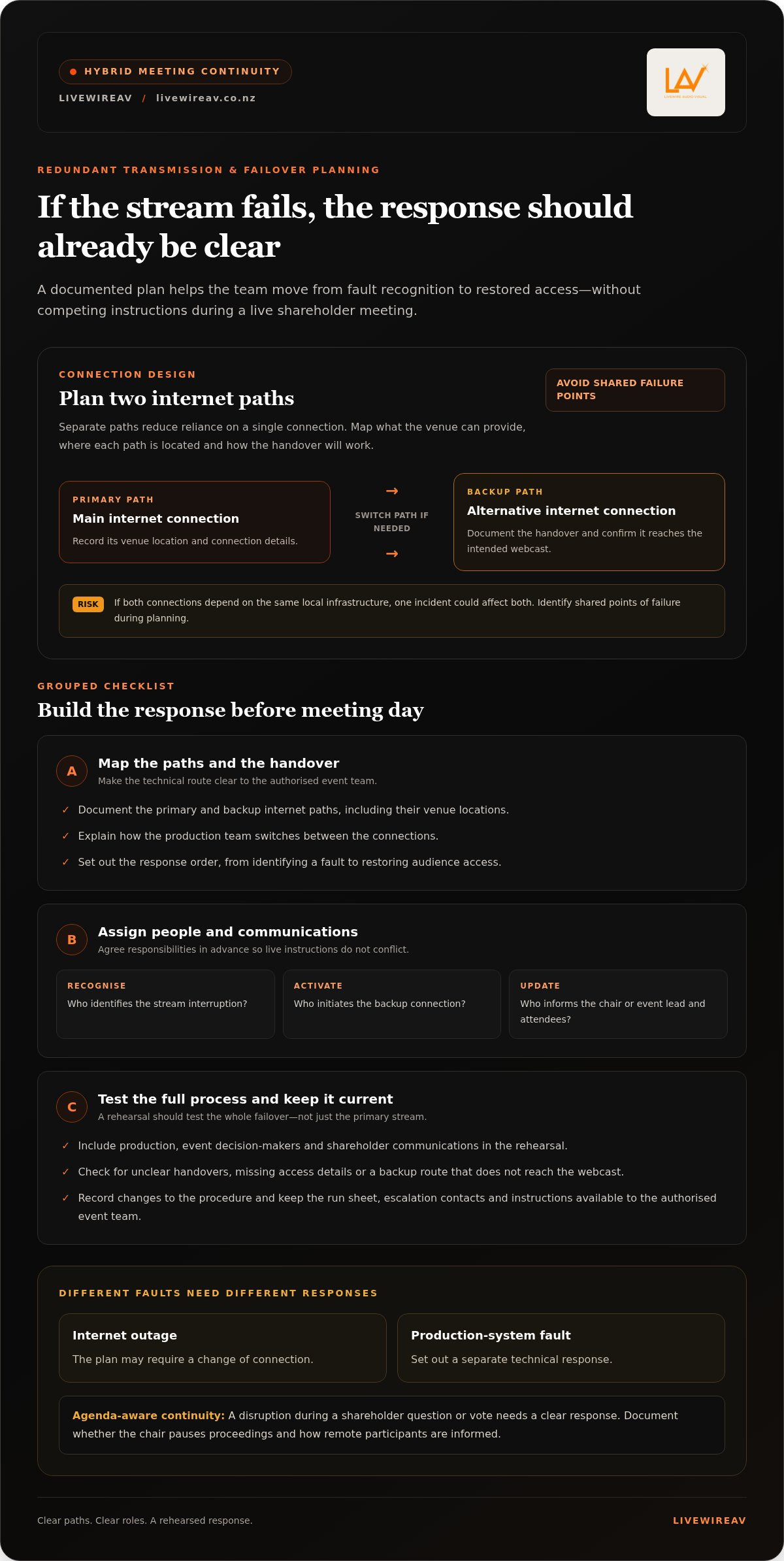
A hybrid shareholder meeting relies on a transmission path between the venue and online attendees. A documented redundancy plan explains what happens if the primary internet connection or streaming system fails. It should identify the backup path, who activates it and how the meeting continues during the changeover.
Separate internet paths reduce reliance on a single connection. Identify each path and explain how the production team will switch between them. If both connections depend on the same local infrastructure, one incident could affect both. Map the venue’s available connections and identify shared points of failure during planning.
Write the live failover procedure in plain language. Specify who recognises a stream interruption, who initiates the backup connection and who communicates with the chair or event lead. Assigning these responsibilities in advance helps prevent conflicting instructions during a live incident.
Document the primary and backup internet paths, including their venue locations and connection handover process.
Set out the order of response, from identifying a fault to restoring the audience’s access.
Agree how the chair and attendees will be updated if the stream pauses or changes.
Test the full process before the meeting, not just the primary stream. A rehearsal can uncover unclear handovers, missing access details or a backup route that does not reach the intended webcast. Include the people responsible for production, event decisions and shareholder communications, then record any changes to the procedure.
Plan for different failure points. An internet outage may require a connection change, while a production-system fault may need a separate technical response. The incident plan should distinguish these scenarios and clarify who decides whether proceedings pause. Keep the run sheet, escalation contacts and failover instructions available to the authorised event team.
Align the backup process with the meeting agenda. A disruption during a shareholder question or vote needs a clear response, including whether the chair pauses proceedings and how remote participants are informed. Documenting separate internet paths and live failover procedures helps the team act consistently.
What audiovisual equipment is needed for a shareholder meeting in New Zealand?
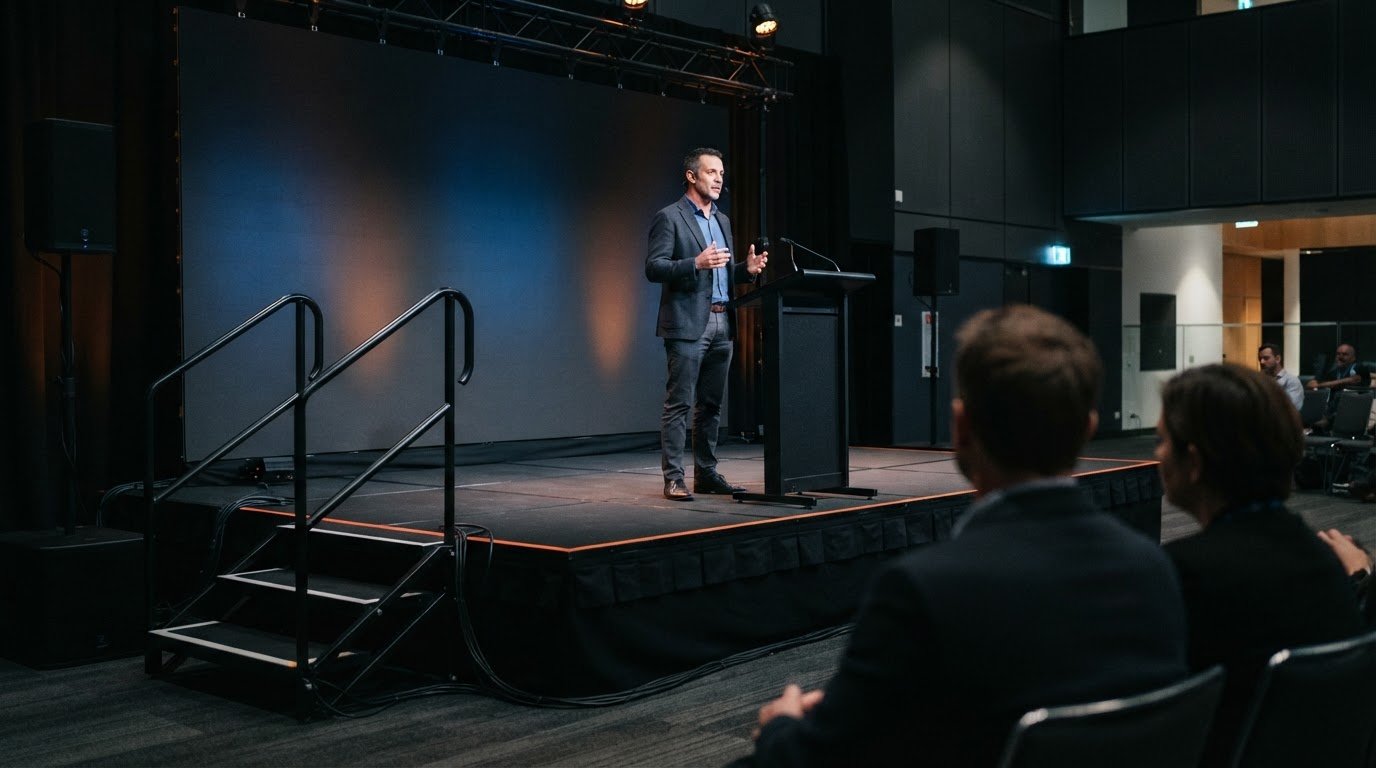
The equipment plan depends on the room, agenda and whether shareholders are joining remotely. For an in-person AGM, start with microphones for the chair, presenters and audience questions, plus a sound system that reaches every seat. A lectern microphone alone may not capture discussion from shareholders around the room.
Screens or projection make financial statements, resolutions and speaker names easier to follow. Camera positions should show the chair, presenters and relevant slides without obstructing sightlines. A vision switcher lets the production team select the appropriate camera or presentation feed as the meeting moves between speakers and agenda items.
A hybrid meeting adds a camera feed, livestream encoding and a suitable internet connection to the room setup. Remote attendees need to hear both the stage and audience questions, so the microphone mix must include each source. The webcast operator also needs a clear view of the running order, including when votes open and when the chair takes questions.
Audio: Microphones for speakers and audience questions, supported by a room sound system.
Video: Cameras covering the chair, presenters and discussion, with vision switching between sources.
Displays: Screens or projection for slides, resolutions and other meeting information.
Livestream: Encoding and internet access to carry the selected audio and video feeds to remote attendees.
Venue layout affects where cameras, screens and microphones will work effectively. A long room, for example, may need different camera positions from a boardroom, while managing question microphones can be harder with a large audience. Map seating, the stage, sightlines and cable routes before placing equipment. Then test speech, slides and audience questions in the room and on the online feed. This shows whether sound is clear and visuals remain legible in both settings.
Match the equipment plan to the meeting’s content. A presentation-heavy AGM needs reliable slide switching; a meeting with substantial discussion needs well-managed audience microphones. In New Zealand, shareholder meeting technical production should account for both the venue experience and remote access so each part of the programme is easy to follow.
How do you choose a technical production company for a shareholder meeting?
Choose a production partner based on how clearly it can coordinate the meeting’s people, systems and deliverables. A shareholder meeting technical production brief should connect the agenda with technical responsibilities, approval routes and post-event outputs. This helps legal, investor-relations and production teams work from the same plan.
Start with accountability. A producer should provide one point of contact for cross-functional approvals and clear escalation paths during the event. This matters when a disclosure, question or vote needs a timely decision. Confirm how the production lead will communicate with the chair and event team, and who will handle technical incidents or changes to the running order.
Assess the production workflow, not just the equipment list. Presentation content needs a defined review and approval process, while webcast registration and viewing pages should be tested against expected concurrent attendance. Include access controls, stream encryption, watermarking and attendee authentication in the production plan. These details show how the workflow supports controlled access and consistent information handling.
Agree on recording and archive deliverables before the meeting. A post-event package can include master recordings, chaptered edits, searchable transcripts and time-coded logs. The production agreement should also set out who owns raw media, how long files are retained, when edited assets are delivered, and how sensitive material is redacted or removed. While business proceedings require formal enterprise archiving, company leaders interested in capturing personal narratives or family histories can turn to dedicated oral history tools such as Lumenairi.
If shareholders need translation, include simultaneous interpretation feeds and latency reporting in the technical scope. This allows the team to plan for interpretation in the programme and monitor timing between the spoken meeting and translated audio. Clear scope, ownership and escalation are practical signs of a well-managed production relationship.
For support aligning technical responsibilities with your AGM agenda, discuss your meeting production requirements.
LivewireAV: Full Technical Production
LivewireAV provides Full Technical Production for shareholder meetings that need coordinated audiovisual and livestream planning. Turn to the team when you need production organised around the meeting’s agenda, venue and audience format.
For hybrid proceedings, Hybrid & Livestream Events support delivery to remote participants. LED Walls & Projection can present meeting content in the room, while Audio Line Array Systems support clear sound for attendees. The right combination depends on the venue and how shareholders will participate.
Share the meeting format, venue details and key programme requirements to begin planning. For shareholder meeting technical production, contact LivewireAV or visit livewireav.co.nz.
Set the production plan in motion
Once the meeting’s decisions, format and audience needs are clear, the next step is to bring them together in one production plan. Good shareholder meeting technical production connects technical choices to how the meeting needs to run, rather than treating each system as a separate task. This gives internal teams a practical basis for confirming responsibilities, approvals and event priorities.
LivewireAV offers Full Technical Production for coordinated event delivery, alongside Hybrid & Livestream Events for remote participation and LED Walls & Projection for presenting content in the room. The right scope starts with the meeting itself: its format, venue and programme. Planning can then focus on the details that support the experience you want shareholders to have.
Bring your agenda, venue information and participation requirements into the planning conversation. A shared view of these priorities helps shape a production approach around the meeting, not just the equipment. Contact LivewireAV to plan your meeting and take the next step with a clear, considered production plan.
Frequently Asked Questions
What does technical production for a shareholder meeting include?
What are the risks and backup plans for shareholder meeting livestreams and voting technology?
Internet interruptions, unclear voting instructions or mismatched result reporting can disrupt remote participation. Plan a response for a lost stream, including who informs the chair and attendees and whether proceedings pause. For voting, agree in advance how the chair receives and announces results, and how an interruption affects the vote. Rehearsing a sample agenda item can reveal unclear handovers before the meeting begins.
Comments